However, if you are telling the story of a wrongfully convicted person, you are asking those same terribly injured people to suspend their absolute belief that the person who was convicted of the crime is the person who harmed them or their loved ones. This is a whole different proposition and one that not many victims and their supporters can tolerate. A lot of them have been moving through their lives, sometimes for decades, safe in the knowledge that the right person is in prison. The writer not only re-opens the old painful wounds caused by the loss of their loved one again, but inflicts a new pain: the thought that perpetrator may still be at large.
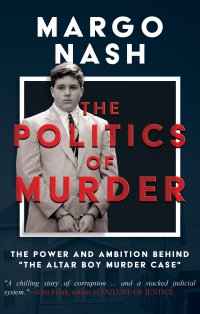
In my book, The Politics of Murder, I am asking exactly that of those who suffered through the loss of Janet Downing in July of 1995. Believe me, I understand what a horrific proposition I have put before them. I thought long and hard about that during the entire year I was researching and writing this book.
What kept me going was my belief that exposing the facts as I unraveled them from the evidence and the testimony in this case, could possibly – just possibly – expose Janet Downing’s real murderer. If Janet Downing was my friend, mother, sister, wife, aunt, daughter, neighbor I would want to know that the investigation into her murder was as thorough as possible and that every conceivable piece of evidence was analyzed before any conclusions were made. I’d want to know that the state did everything in its power to track down all the clues and follow every evidentiary thread until there was absolute certainty about the perpetrator.
In my opinion Janet Downing didn’t get the thorough investigation that she deserved. In my opinion, the state didn’t really care about who killed Janet Downing, they cared only about getting a conviction and convincing the public and the friends, family and neighbors of Janet Downing that the person they convicted was the perpetrator. The Middlesex District Attorney’s office already had one very public unsolved murder in Somerville when Janet Downing was murdered. The city was up in arms because what seemed like a straightforward case was mired in confusion following her murder.
Unsolved murders are bad for business if you are a district attorney. People don’t vote for you when you can’t solve murders.
Under DA Tom Reilly’s watch, two high profile murders went unsolved in Middlesex County:
- On April 4, 1991, Mary Jo Frug was stabbed to death at dinnertime in Cambridge near the home that she shared with her husband, Harvard Law professor Gerald Frug. No one has ever been charged with the murder.
- Four days after her 17th birthday, Deanna Cremin was strangled to death one block from her home in Somerville in March of 1995. No one has been charged for the murder.
Janet Downing’s murder happened just four months after Deanna’s. The pressure to solve this crime was enormous. And the rush to judgment was quick, based on fingerprints identified at the scene belonging to Eddie O’Brien.
But other fingerprints were found at the scene – other bloody fingerprints – in fact a whole bloody palm print was found. It didn’t belong to Janet Downing. It didn’t belong to Eddie. It didn’t belong to anyone in the Downing household. Whose bloody palm print was it? Wouldn’t you like to know? I know I would. I’d also like to know the identity of the male DNA on the alleged murder weapon, wouldn’t you? It wasn’t Eddie’s. Nor was the DNA under Janet’s fingernails Eddie’s.
Doesn’t Janet deserve at least that much? Doesn’t her family?
I understand how painful this is. I understand how angry people are for re-opening these painful memories and a previously closed chapter in their lives. I understand why they post angry messages on social media. I’m angry, too.
On the very day she was so brutally murdered, Janet Downing pleaded with her friend to promise her that if anything like what happened to Deanna ever happened to her, she would make the police “investigate, investigate, investigate.”
After attending all of the court hearings, and reading all the juvenile transfer hearing transcripts, the trial transcripts, all of the forensic reports, psychological reports, laboratory analyses of the blood work and DNA, the correspondence, the investigatory reports, the police reports and the witness statements, I came to the conclusion that what Janet Downing begged for that day was never done. The police did not investigate, investigate, investigate.
Do I believe that Eddie O’Brien is innocent? I most assuredly do. But more importantly, I believe whoever murdered Janet Downing can still be found. Janet Downing wanted a thorough investigation. The only person who wouldn’t want all these questions answered would be Janet Downing’s real murderer. He’s the only one with something to lose.
]]>
Once I’d committed to writing the story of Eddie O’Brien’s arrest, legal journey and trial, I sat down at the computer and wondered exactly how one organizes a book. Should I start with an outline? I realized I had no idea how to organize a book. I didn’t know anyone who had written a book who I could ask. Finally I decided that perhaps I should just start writing and see where that took me.
I knew I wanted to start with the day of Janet Downing’s murder from Eddie’s point of view. That led seamlessly into telling the story of the same day from another important person’s point-of-view, Gina Mahoney, who spent the entire day with Janet before she was murdered so brutally the night of July 23, 1995. The book’s organization evolved organically, as I introduced the main characters in the story. It made perfect sense, then, when I moved to the “legal” part of the story to tell it as it unfolded day by day during the long days of the trial.
I recently remarked to a colleague “the book really wrote itself.” Letting the book evolve during the writing process, turned out to be the most authentic way to write The Politics of Murder.
As I moved through the trial transcripts, inch by inch, I was struck by something I had not even considered at the outset of the story: what an overwhelming experience it is to be a juror. I had to translate the legalese language for the reader, so the book didn’t sound like a textbook. But no one did that for the jurors. They were thrown into a world where they were bombarded with legal terms they didn’t understand (or worse, misunderstood), instructions that actually were from a legal textbook. They had to sit for days through the most complex scientific testimony that used acronyms like RFLP and PCR, neither of which was made clearer by its full name. And they couldn’t take any notes. Eleven full days of trial testimony and exhibits and chalks, followed by two hours of closing arguments, then three hours of non-stop jury instructions on the law that they were bound to adhere to in coming to a unanimous decision. At one point I sent the entire 86 pages of Jury Instructions to a friend to ask her how much of them I needed to include in the manuscript. She wrote back:
“Saying that they are tedious, confusing, mind-numbing, and seemingly contradictory just doesn’t capture it.”
I knew then that I wanted to give the reader a sense of just how hard it is to be a juror, especially in a case where your decision may send a child to jail for life. Thus, the story evolved to include something I’d never even considered including in the book.
We (lawyers and judges) expect much more of jurors than we like to admit. What’s worse is that we constantly make fun of them: “Jurors are people who are too stupid to get out of jury duty.”
I gained a whole new respect and understanding of jurors in writing this book. I hope that you will too.
THE POLITICS OF MURDER: The Power And Ambition Behind “The Altar Boy Murder Case” is coming from WildBlue Press on November 22, 2016! Pre-order your copy today to save!

https://wildbluepress.com/politics-of-murder-margo-nash-writing-process/
]]>